All about miscellaneous expenses

Miscellaneous costs are normal, necessary, and reasonable costs that a business must pay to run. To be more specific, an investment cost would include losses from selling property or shares on the stock market at the wrong time or because the market changed. On the other hand, miscellaneous expenses refer more specifically to day-to-day costs that don’t bring in any money, like grocery bills and travel costs. On the other hand, start-up costs are one-time costs like legal fees, accounting why does alcohol make you hot services, and permits that must be paid before operations can begin. Start-up costs do not recur every month as miscellaneous expenses do; instead, they are fixed amounts paid at given points throughout the establishment process of a new business. When it comes to financial reporting, you’ll find miscellaneous expenses detailed on the income statement.

  • This classification keeps them organised as part of regular business costs without directly linking them to production or other primary categories.
  • The IRS thinks you are not using a calculator for business activities even if you do.
  • Another way to avoid unnecessary spending is to buy office supplies, merchandise and consumables in bulk.
  • The company spends Rs. 10,000 extra for those special logos and sticks them on the 500 shoes.
  • It can help them figure out where they’re spending too much and make the changes they need to make to keep their budget in good shape.
  • However, you need to track each miscellaneous expense, regardless of high or low cost.
  • A sample presentation of an income statement that includes a miscellaneous expense line item appears in the following exhibit.

Stay updated with Fyle by signing up for our newsletter

As tax law can change frequently, it’s advisable to consult with a tax professional for the most current rules and regulations. Miscellaneous expenses are infrequent costs that are not included in regular business expenditures and also vary in size and time because they are not predictable. In terms of accounting, not all miscellaneous expenses fall under tax deductible as most of them aren’t liquidity in small business related to your business in the eyes of the IRS. Deduct all management and administration fees you pay for the operation of your small business, including bank charges. If your business accepts credit cards and pays processing charges, tracking these miscellaneous expenses in QuickBooks simplifies including them when filing your tax returns. These expenses encompass a wide array of items, including office supplies, travel costs, and minor repairs.

Maximising Tax Deductions

You could set aside 2-5% of your average monthly income to cover these small but necessary costs. Keep in mind that, as a small business owner, you may have some nonprofit fundraising, part 2 restrictions, such as those on the amount of interest that’s deductible for purchases of vehicles and vacant land. If you have a home office, deduct your interest on your home mortgage as an expense related to the business use made from your home. Businesses must plan for these unknown costs in their budgets so they don’t lose money or have problems with cash flow.

Tools like Vyapar app can make tracking much easier and more accurate, though it’s not necessary. Instead, you could purchase almonds, peanuts, dried fruits and other healthy foods in bulk and make your own snacks. Likewise, you can save hundreds of dollars a month just by making coffee, smoothies and fruit juices at home.

  • You can instantly add expense receipts in the software without any separate ledger account.
  • By tracking and categorising miscellaneous expenses, you gain control over your finances, maximise tax benefits, and uncover cost-saving opportunities.
  • Like reservists, performing artists use Form 2106 to report these expenses as adjustments to income, allowing them to deduct their expenses directly against income rather than as itemized deductions.
  • Taking proactive measures to anticipate and mitigate unanticipated expenses can prevent financial strain and enable a more sustainable financial position.
  • Their impact on company expenditure can be significant, especially for businesses with frequent travel requirements.
  • Therefore, maintaining accurate financial records is crucial for monitoring and controlling these costs.
  • But if you only go to the gym occasionally, then it’s a miscellaneous expense – simply put, it’s not something you budget for.

Miscellaneous Expenses: Definition, Deductible Expenses and Examples

They can deduct these miscellaneous expenses, meaning the income they’re taxed on will be reduced. Additional miscellaneous expenses include parking fees, postal fees, and incidental travel expenses. Businesses must pay close attention to how much money is spent on miscellaneous expenses, as it can quickly add up if not managed properly. By carefully tracking and analyzing these costs, businesses can find places to save money and make changes to stay profitable. Businesses incur additional costs, known as miscellaneous expenses, that are unrelated to their primary operations. They typically cover small, non-recurring expenditures, such as items bought for the office, business trips, and other similar fees.

Miscellaneous Expenses are Not Hobby-Related Expenses

These losses qualify as casualty theft losses, which are claimable on Form 4684 as miscellaneous business expenses. Businesses can deduct costs for services or modifications that enable employees with disabilities to work, like specialized equipment or attendant care. Deduct these expenses directly on Schedule 1 (Form 1040) as an adjustment to gross income. Miscellaneous expenses are a necessary, albeit tricky, part of running any business. They often cover a broad range of small, seemingly random costs that don’t fit into specific categories.

How Do Miscellaneous Expenses Affect a Company’s Financial Statements?

Tools and supplies refer to items that are necessary for the operation of your services (such as small tool expenses) and can be categorized as miscellaneous expenses. Typically, tools with a lifespan of one year or less are worth less than $200 and would fall under this category. Good decision-making depends on good data that accurately shows the current situation. In this case, the miscellaneous expense account could help keep track of the cost of the contractor’s services and any other costs, like travel costs, that went along with them. Miscellaneous expenses can also be a tool for businesses to manage their cash flow. If companies can see these costs more clearly, they can manage their money more effectively.

The following are a few frequently asked questions about this tax category, and how FreshBooks can help you stay organized during tax time. Business travel is one of those incidental expenses that comes with certain types of work. You may need to cover commuting expenses, meals, lodging, and other expenses while on the road. For example, expenses incurred during a temporary work assignment or for conventions can be included as a write-off according to the IRS, as long as they’re proven to be necessary and benefit the business.

This category is given its own aggregated line on an income statement account for clear and concise tax return-filing purposes. Miscellaneous expenses are small transactions and costs that do not fit within the ledgers’ specified accounts or a specific tax category. These expenses must be recorded and accounted for in your business’ general ledger. In the event the items classed as miscellaneous expenses increase in size and usage, then the miscellaneous expenses should be given its own account.

Organizations can better understand their total financial picture and plan accordingly by tracking miscellaneous expenses separately. This category is given its own aggregated line on an income statement account for clear and concise tax return-filing purposes. A tax deduction can be made on miscellaneous expenses for business use based on your country’s regulations.

6 7: Product vs. Period Costs Business LibreTexts

Under different costing system, product cost is also different, as in absorption costing both fixed cost and variable cost are considered as Product Cost. On the other hand, in Marginal Costing only the variable cost is regarded as product cost. An example of such cost is the cost of material, labour, and overheads employed in manufacturing a table. Period costs are the expenses in a business that aren’t directly linked to making specific products or services. Instead, they’re more about keeping the business running smoothly and supporting its overall operation.

Thus, it is fair to say that product costs are the inventoriable manufacturing costs, and period costs are the nonmanufacturing costs that should be expensed within the period incurred. This distinction is important, as it paves the way for relating to the financial statements of a product producing company. And, the relationship between these costs can vary considerably based upon the product produced. They are the costs that are directly and indirectly related to producing an item. This means that these costs directly impact the income statement for the specific time frame.

Our priority at The Blueprint is helping businesses find the best solutions to improve their bottom lines and make owners smarter, happier, and richer. That’s why our editorial opinions and reviews are ours alone and aren’t inspired, endorsed, or sponsored by an advertiser. Take your learning and productivity to the next level with our Premium Templates.

This additional information is needed when calculating the break even sales level of a business. It is also useful for determining the minimum price at which a product can be sold while still generating a profit. Production Accounting gives an insight into the cost of goods manufactured for your products, so that you can control the manufacturing costs during the production process. A soft drink manufacturer might spend very little on producing the product, but a lot on selling. Conversely, a steel mill may have high inventory costs, but low selling expenses. When inventory is purchased, it constitutes an asset on the balance sheet (i.e., “inventory”).

  • CFI is on a mission to enable anyone to be a great financial analyst and have a great career path.
  • These unsold units would continue to be treated as asset until they are sold in a following year and their cost transferred from inventory account to cost of goods sold account.
  • If you are manufacturing your products in a repetitive manufacturing (REM) environment, you always use Product Cost by Period.
  • These are incurred whether the business manufactures or acquires goods and are considered indirect costs of production.
  • Period costs are not attached to products and the company does not need to wait for the sale of its products to recognize them as expense on income statement.

Product costs, also known as direct costs or inventoriable costs, are directly related to production output and are used to calculate the cost of goods sold. Direct material costs are the costs of raw materials or parts that go directly into producing products. For example, if Company A is a toy manufacturer, an example of a direct material cost would be the plastic used to make the toys.

Synder Unveils AI Dashboards: Natural Language Reports for Real-Time Retail & SaaS Financial Insights

People often confuse product and period costs due to the complexity of accounting terminology and the different ways these costs are treated in financial reporting. One unique aspect of product costs is their treatment as assets until the product is sold. product versus period costs Instead of being immediately expensed, product costs are capitalized, meaning they are recorded on the balance sheet as an asset.

Most of the components of a manufactured item will be raw materials that, when received, are recorded as inventory on the balance sheet. Only when they are used to produce and sell goods are they moved to cost of goods sold, which is located on the income statement. When the product is manufactured and then sold a corresponding amount from the inventory account will be moved to the income statement. So if you sell a widget for $20 that had $10 worth of raw materials, you would record the sale as a credit (increasing) to sales and a debit (increasing) either cash or accounts receivable. The  $10 direct materials would be a debit to cost of goods sold (increasing) and a credit to inventory (decreasing).

The difference between product costs and period costs

Rather than being listed as inventory, period costs are listed as expenses for each accounting period. The product costs are sometime named as inventoriable costs because they are initially assigned to inventory and expensed only when the inventory is sold and revenue flows into the business. Product costs (direct materials, direct labor and overhead) are not expensed until the item is sold when the product costs are recorded as cost of goods sold. Period costs are selling and administrative expenses, not related to creating a product, that are shown in the income statement in the period in which they are incurred. Period costs include selling expenses and administrative expenses that are unrelated to the production process in a manufacturing business.

Comparing Product Costs and Period Costs

Period costs are costs that cannot be capitalized on a company’s balance sheet. In other words, they are expensed in the period incurred and appear on the income statement. The costs incurred from logistical transactions on the production version such as goods issues, confirmations, and goods receipts are updated directly on the PCC.

Explaining the Product Cost by Period Approach

  • The simple difference between the two is that Product Cost is a part of Cost of Production (COP) because it can be attributable to the products.
  • It’s like finding the right balance to make good products and keep the entire business in good shape.
  • A business can go through periods where it doesn’t have any product costs, but there will still be period costs as these are unrelated to the ebb and flow of production.
  • The classification of costs as product or period affects how they are reported in financial statements.
  • On the other hand, in Marginal Costing only the variable cost is regarded as product cost.
  • So if you pay for two years of liability insurance, it wouldn’t be good to claim all of that expense in the period the bill was paid.

This depends on whether the labor is directly related to production or not – a factory worker’s wages would be product costs, while a company secretary’s wages would be period costs. A business can go through periods where it doesn’t have any product costs, but there will still be period costs as these are unrelated to the ebb and flow of production. Instead, they’re related to the passing of time and any time-based expenses like utility bills and rent. Administrative expenses are non-manufacturing costs that include the costs of top administrative functions and various staff departments such as accounting, data processing, and personnel.

Examples of period costs are general and administrative expenses, such as rent, office depreciation, office supplies, and utilities. In general, overhead refers to all costs of making the product or providing the service except those classified as direct materials or direct labor. Manufacturing overhead costs are manufacturing costs that must be incurred but that cannot or will not be traced directly to specific units produced. In addition to indirect materials and indirect labor, manufacturing overhead includes depreciation and maintenance on machines and factory utility costs.

Product Cost by Period enables periodic analysis of costs at the product level. It enables you to collect costs at the product level independently of the production type. By mastering the principles of cost classification, businesses can gain deeper insights into their financial health and make informed decisions that drive long-term success. Today, we’re breaking down these two concepts to understand their general aspects, relationship with financial statements, and overall impact on business decision-making.

They’re often broken down into subcategories of fixed and variable costs, which can be used for calculating things like the break-even point. When a company sells its products, the product costs form part of the cost of goods sold (COGS) on the income statement. Firms account for some labor costs (for example, wages of materials handlers, custodial workers, and supervisors) as indirect labor because the expense of tracing these costs to products would be too great.

Once sold, these costs are transferred to the cost of goods sold (COGS) on the income statement. Based on the association with the product, cost can be classified as product cost and period cost. Product Cost is the cost that is attributable to the product, i.e. the cost which is traceable to the product and is a part of inventory values. On the contrary, Period Cost is just opposite to product cost, as they are not related to production, they cannot be apportioned to the product, as it is charged to the period in which they arise. Let’s say you’re considering hiring more staff to handle the increasing number of orders. By looking at period costs, you can evaluate the impact of such decisions on the bakery’s overall financial health.

Some expenses, such as utility bills, may have components that qualify as both product and period costs, requiring allocation. Many employees receive fringe benefits paid for by employers, such as payroll taxes, pension costs, and paid vacations. These fringe benefit costs can significantly increase the direct labor hourly wage rate. Other companies include fringe benefit costs in overhead if they can be traced to the product only with great difficulty and effort. Balancing product and period costs is important for your business performance efficiency. Product costs help you fine-tune the price of each item you sell, ensuring profitability.

Businesses must accurately classify these costs to determine taxable income. As a general rule, costs are recognized as expenses on the income statement in the period that the benefit was derived from the cost. So if you pay for two years of liability insurance, it wouldn’t be good to claim all of that expense in the period the bill was paid. Since the expense covers a two year period, it should be recognized over both years. Period costs describe a business’s additional costs incurred during a specific reporting period. While they still form part of the overall cost of running a business, they aren’t directly related to manufacturing a specific good or service.

The key difference between product cost and period cost is that product concurs when a company produces any products. Consequently, they are not apportioned to any product but charged as an expense in the income statement. According to the Matching Principle, all expenses are matched with the revenue of a particular period. So, if the revenues are recognised for an accounting period, then the expenses are also taken into consideration irrespective of the actual movement of cash.

What is Invoice Financing & How Does It Work? +Pros & Cons

what is invoice financing

Nevertheless, efficient invoice management cannot be achieved without digitization, especially invoice scanning. Before this technology, accounts payable teams had to manually enter data, which consumed valuable time and resources. Invoice scanning has changed that, automating much of the work and making the entire process more streamlined and efficient.. Invoice scanning is a crucial step in managing the accounts payable (AP) process for any business. You may think that invoice scanning is no longer required if invoices are received electronically. You can contact us to learn more about invoice financing or other small business loans.

Receive Your Advance

what is invoice financing

Invoice discounting is a type of invoice financing where a business retains control over collections and customer relationships. Instead of selling invoices outright to a financing company, the business borrows against the value of its unpaid invoices, using them as collateral to secure a loan. The lender advances a percentage of the invoice value upfront, typically 70-90%, minus a discount or interest rate. The business retains responsibility for collecting payments from customers and repays the loan, along with any fees or interest, once the invoices are paid.

Minimise financial admin and focus on growing your business with accounts payable software

  • So overall, B gets its own money back and 3% of fees on $5,000, which is $150.
  • The platform automates invoicing processes, meaning you can pay suppliers quickly without constantly having to double-check invoices and complete transactions yourself.
  • The invoices are the collateral for the loan, so you don’t have to put additional business assets at risk.
  • So, while you do receive a cash advance upfront, you ultimately do pay a fee for this service.

Invoice financing is a useful tool to smooth out cash flow, but it’s not your only option. Ramp’s industry-leading corporate card can give you access to credit limits up to 30x higher than traditional business credit cards. Invoice financers will require you to pay fees and/or interest on what you borrow. As you’ll notice from the list above, different software solutions are more suitable for different business industries and sizes. For example, Juni is spend management software built with the needs of ecommerce companies in mind.

The Bankrate promise

You can apply for either a loan or line of credit with inventory financing. The amount you can borrow is based on the value of your business’s inventory, but typically, you can only qualify for between 20% and 65%. Lenders may also use liquidation value as a starting point, as some types of inventory can lose value over time. Invoice financing and invoice factoring are terms that are easy to confuse.

what is invoice financing

Understanding the steps involved can help you make the most of this financing option and avoid potential pitfalls. The fact that your collateral is your invoice may mean some types of businesses immediately won’t qualify. B2C (business to consumer) companies looking for financial help may be out of luck, especially if their cash flow originates at a point-of-sale machine rather than long-term invoices. So, while you do receive a cash advance upfront, you ultimately do pay a fee for this service. The factoring company profits from the difference between the cash advance and the total amount you repay.

what is invoice financing

Many companies in the tech sector are contending with fast-paced growth, international vendor relationships, and subscription-based expense models. With automated invoice scanning, tech companies can enjoy scalable processes, seamless integration with ERP and CRM systems, and real-time reporting for better decision-making. The financial services sector also deals with large transaction volumes and the need for strict security and fraud prevention measures. Streamlined invoice scanning can enhance fraud detection, fast-track payment approvals, and improve regulatory compliance.

After the financier has recovered the amounts due, they will forward the remaining funds to the business, deducting a nominal service fee. Invoice factoring is a form of invoice finance where you bring your B2B accounts receivable to a financing company. This financier then provides you with a substantial portion (typically up to 85%) of the invoices’ value immediately in exchange for a small fee. With invoice financing, your business typically keeps control of customer relations and the collection of your invoice funds.

A Quick Guide to GAAP Accounting for Your Business

  • However, the business needs immediate funds to cover operational expenses or invest in expansion.
  • While invoice financing is expensive, you can keep your costs down if your customers pay on time.
  • Invoice financing is a useful tool to smooth out cash flow, but it’s not your only option.
  • Invoice factoring is a form of invoice finance where you bring your B2B accounts receivable to a financing company.
  • The lender advances a percentage of the invoice value upfront, typically 70-90%, minus a discount or interest rate.
  • It goes to bank B and asks for invoice financing after showing its receivables invoices.

The lender also limits its risk by not advancing 100% of the invoice amount to the borrowing business. Invoice financing does not eliminate all risk, though, since the customer might never pay the invoice. This would result in a difficult and expensive collections process involving both the bank and the business doing invoice financing with the bank. According to estimates, 80% of businesses are expecting growth in the volume of invoices their AP teams Certified Bookkeeper will process in the coming years. Considering this increase in volume, automated invoice scanning can help companies save on manual data entry and avoid late payment penalties. While both of these types of invoice finance have their benefits – they tend to be expensive and may take time to be assessed and approved.

What is the statement of stockholders’ equity?

In its simplest form, shareholders’ equity is determined by calculating the difference between a company’s total assets and total liabilities. The statement of shareholders’ equity highlights the business activities that contribute to whether the value of shareholders’ equity goes up or down. The statement of shareholders’ equity is a financial document a company issues as part of its balance sheet. It highlights the changes in value to stockholders’ or shareholders’ equity, or ownership interest in a company, from the beginning of a given accounting period to the end of that period. Typically, the statement of shareholders’ equity measures changes from the beginning of the year through the end of the year. It can also be called “owners’ equity” or “shareholders’ equity.” It can be found on a firm’s balance sheet and financial statements, along with data on assets and liabilities.

  • Finally, the number of shares outstanding refers to shares that are owned only by outside investors, while shares owned by the issuing corporation are called treasury shares.
  • During a liquidation process, the value of physical assets is reduced and there are other extraordinary conditions that make the two numbers incompatible.
  • In Note 6 to the financial statements on page 56, we see there were in fact four million shares issued to employees as part of their non-cash compensation.
  • Adam received his master’s in economics from The New School for Social Research and his Ph.D. from the University of Wisconsin-Madison in sociology.
  • The accounting procedure for dealing with treasury stock is very important to understand.

This is done either to increase the value of the existing shares or to prevent various shareholders from controlling the company. The stake of the owner or the firm’s share that is allotted as equity or stock is known as preferred stock. The asset distribution and the dividend share are greater for preferred stockholders when compared to the common stockholders. The statement of shareholders’ equity allows the senior management to keep an eye on the status of the selling of additional shares.

How You Use The Shareholders Equity Formula To Calculate Stockholders Equity For A Balance Sheet?

The IRS requires detailed documentation, including logs and receipts, to validate these claims. Failure to maintain proper records can result in overstated or understated deductions, increasing the risk of audits. I’ve spent the last 2 days learning this system (it’s very cool), but there are a few minor outstanding questions, where no matter how much I read about them, it’s not „clicking”. For the past 52 years, Harold Averkamp (CPA, MBA) hasworked as an accounting supervisor, manager, consultant, university instructor, and innovator in teaching accounting online. For the past 52 years, Harold Averkamp (CPA, MBA) has worked as an accounting supervisor, manager, consultant, university instructor, and innovator in teaching accounting online.

Your firm, integrated

All the information needed to compute a company’s shareholder equity is available on its balance sheet. Retained earnings are part of shareholder equity as is any capital invested in the company. Lastly, some individuals mistakenly assume that making estimated tax payments exempts them from penalties. To avoid underpayment penalties, estimated payments must be calculated accurately based on projected income. Contributions to self-employed retirement plans, such as SEP IRAs or Solo 401(k)s, further adjust reportable income, offering both immediate tax deferral and long-term financial benefits. Similarly, retained earnings drop with the increase in dividend payment and vice versa.

However, eligibility depends on factors such as income thresholds and whether the business qualifies under specified service trade or business rules. Adjustments to income, such as contributions to self-employed retirement plans or health insurance deductions, can further reduce net earnings. These adjustments lower taxable income and, in turn, the amount reported on Line 7. Information provided on the World Wide Web by Smith Elliott Kearns & Company, LLC is intended for reference only.

What Is the Cleaning Services Business Code for Tax Filings?

Long-term assets are the value of the capital assets and property such as patents, buildings, equipment and notes receivable. Aside from stock (common, preferred, and treasury) components, the SE statement includes retained earnings, unrealized gains and losses, and contributed (additional paid-up) capital. Many investors view companies with negative shareholder equity as risky or unsafe investments. But shareholder equity alone is not a definitive indicator of a company’s financial health. If used in conjunction with other tools and metrics, the investor can accurately analyze the health of an organization.

Does Prepaid Rent Affect Net Income?

A negative shareholder equity signifies that the company’s liabilities exceed its assets. Shareholder equity represents the accounting value of the company, while market value refers to the total market capitalization of a publicly traded company’s outstanding shares. To calculate net self-employment earnings, aggregate all income from business activities, including payments for services, product sales, and other revenue streams.

SE is a number that stock investors and analysts look at when they’re evaluating a company’s overall financial health. It helps them to judge the quality of the company’s financial ratios, providing them with the tools to make better investment decisions. Deducting business expenses requires careful planning to maximize legitimate deductions while staying compliant. For example, home office expenses are deductible only if the space is used exclusively and regularly for business purposes. Properly accounting for depreciation on long-term assets can also provide significant tax relief over time. The retained earnings portion reflects the percentage of net earnings that were not paid to shareholders as dividends and should not be confused with cash or other liquid assets.

Understanding stockholders’ equity is one way investors can learn about the financial health of a firm. That’s because it doesn’t take much money to produce each dollar of surplus-free cash ​flow. This capital is the extra amount paid for any stocks over the firm’s par value by the investors. It is created when new shares are issued by the firm and further reduced at the time of buybacks.

Successful investors look well beyond today’s stock price or this year’s price movement when they consider whether to buy or sell. Long-term liabilities are obligations that are due for repayment over periods longer than one year. Companies may have bonds payable, leases, and pension obligations under this category. If the company ever needs to be liquidated, SE is the amount of money that would be returned to these owners after all other debts are satisfied.

For some purposes, such as dividends and earnings per share, a more relevant measure is shares “issued and outstanding.” This measure excludes Treasury Shares . Equity typically what is se in accounting refers to shareholders’ equity, which represents the residual value to shareholders after debts and liabilities have been settled. This metric is frequently used by analysts and investors to determine a company’s general financial health.

Information on this web site does NOT constitute professional accounting, tax or legal advice and should not be interpreted as such. The reader accepts the information as is and assumes all responsibility for the use of such information. All information contained on this web site is protected by copyright and may not be reproduced in any form without the expressed, written consent of Smith Elliott Kearns & Company, LLC. Shareholder equity is one of the important numbers embedded in the financial reports of public companies that can help investors come to a sound conclusion about the real value of a company. During a liquidation process, the value of physical assets is reduced and there are other extraordinary conditions that make the two numbers incompatible.

How, when and why do you prepare closing entries?

when closing entries are made

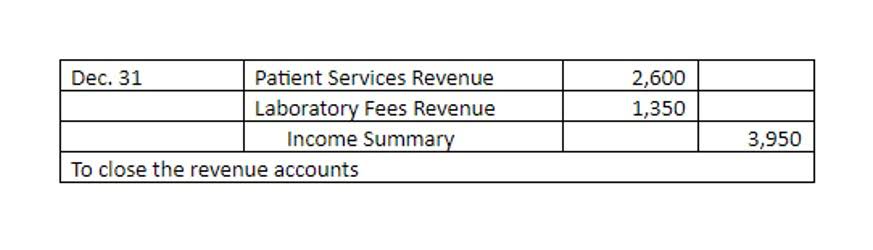
All of Paul’s revenue or income accounts are debited and credited to the income summary account. This resets the income accounts to zero and prepares them for the next year. The retained earnings account is reduced by the amount paid out in dividends through a closing entries debit and the dividends expense is credited. Understanding the accounting cycle and preparing trial balances is a practice valued internationally.

Balance Sheet

when closing entries are made

All modern accounting software automatically generates closing entries, so these entries are no longer required of the accountant; it is usually not even apparent that these entries are being made. Notice that the Income Summary account is Accounting Periods and Methods now zero and is ready for use in the next period. The Retained Earnings account balance is currently a credit of $4,665.

Post navigation

  • Only income statement accounts help us summarize income, so only income statement accounts should go into income summary.
  • The accounting assumption here is that any profit earned during the period needs to be retained for use in future company investments.
  • The balance in Income Summary is the same figure as whatis reported on Printing Plus’s Income Statement.
  • All such information is provided solely for convenience purposes only and all users thereof should be guided accordingly.
  • Permanent accounts, also known as real accounts, do not require closing entries.

However, if the company also wanted to keep year-to-date information from month to month, a separate set of records could be kept as the company progresses through the remaining months in the year. For our purposes, assume that we are closing the books at the end of each month unless otherwise noted. The month-end close is when a business collects financial accounting information. Using the above steps, let’s go through an example of what the closing entry process may look like.

Example of Closing Journal Entries

  • To close that, we debit Service Revenue for the full amount and credit Income Summary for the same.
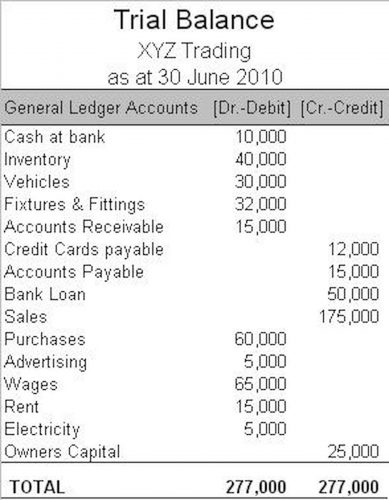
  • Let’s investigate an example of how closing journal entries impact a trial balance.
  • For the past 52 years, Harold Averkamp (CPA, MBA) hasworked as an accounting supervisor, manager, consultant, university instructor, and innovator in teaching accounting online.
  • Our discussion here begins with journalizing and posting theclosing entries (Figure5.2).
  • Closing entries are journal entries made at the end of an accounting period, that transfer temporary account balances into a permanent account.
  • Retained earnings represent the amount your business owns after paying expenses and dividends for a specific time period.

11 Financial is a registered investment adviser located in Lufkin, Texas. 11 Financial may only transact business in those states in which it is registered, or qualifies for an exemption or exclusion from registration requirements. 11 Financial’s website is limited to the dissemination of general information pertaining to its advisory services, together with access to additional investment-related information, publications, and links.

when closing entries are made

Double Entry Bookkeeping

when closing entries are made

These accounts are closed directly to retained earnings by recording a credit to the dividend account and a debit to retained earnings. Permanent accounts, also known as real accounts, do not require closing entries. Examples are cash, accounts receivable, accounts payable, and retained earnings. These accounts carry their ending balances into the next accounting period and are not reset to zero. All the temporary accounts, including revenue, expense, and dividends, have now been reset to zero.

when closing entries are made

What are Temporary Accounts?

when closing entries are made

Do you want to learn more about debit, credit entries, and how to record your journal entries properly? Then, head over to our https://www.bookstime.com/ guide on journalizing transactions, with definitions and examples for business. Now, it’s time to close the income summary to the retained earnings (since we’re dealing with a company, not a small business or sole proprietorship). Keep in mind, however, that this account is only purposeful for closing the books, and thus, it is not recorded into any accounting reports and has a zero balance at the end of the closing process.

Statement of retained earnings definition

Extraordinary items, such as one-time gains or losses, can distort these figures, so analysts must carefully assess underlying profitability trends. You can expand on the information listed in your statement of retained earnings if you want, such as par value of the stock, paid-in capital, and total shareholders’ equity. Or, you can keep your statement of retained earnings short, sweet, and to the point. You must use the retained earnings formula to set up your statement of earnings.

Are Retained Earnings a Debit or Credit?

A summary report called a statement of retained earnings is also maintained, outlining the changes in RE for a specific period. The statement of retained earnings is not one of the main financial statements like the income statement, balance sheet, and cash flow statement. And like the other financial statements, it is governed by generally accepted accounting principles. The statement of retained earnings is important because it shows how much profit a company is retaining and reinvesting into the business, which can be used to finance future growth.

Retained Earnings Vs. Accumulated Earnings: What’s the difference?

The revaluation reserve was not given for the beginning of the accounting period, we will have a zero balance recorded here. We were however given at the end of the accounting period, which was $45,000. Assuming additional 20,000 shares were issued for $60,000 on 31 July 2021 and ordinary dividends declared was $0.35 per share on all shares held at 28 February 2022. Before we can prepare the statement of changes in equity, we need to calculate the balances for the items that were not given in the question. Below is a table showing the 2019 and 2020 Equity section of the Balance sheet of Anael Inc. as at 29 February 2020. Prepare a statement of changes in equity for the company for the year ended 29 February 2020; assume the profit for the year is $81,242 and ordinary dividends declared was $20,000.

How do companies use Retained Earnings?

The formula helps you determine your retained earnings balance at the end of each business financial reporting period. Before we go any further, this is a good spot to talk about your startup accounting. To calculate retained earnings, generate other financial statements, and prepare the report, you need accurate financial data.

Lenders want to lend to established and profitable companies that retain some of their reported earnings for future use. Even if the company is experiencing a slowdown in business activities, it can still make use of the retained earnings to pay down its debt obligations. The statement of retained earnings is mainly prepared for outside parties such as investors and lenders, since internal stakeholders can already access the retained earnings information. Some of the information that external stakeholders are interested in is the net income that is distributed as dividends to investors. You can find the amount on the balance sheet under shareholders’ equity for the previous accounting period.

The Journal Entry for Retained Earnings and Dividends

If management believes the company needs capital to fuel growth, they’ll retain earnings instead of paying them out as dividends. On the other hand, the statement of stockholders’ what are notes to financial statements equity shows how the balance of the shareholders’ equity account changed over the current accounting period. The statement of retained earnings is a financial document that summarizes how the company’s retained earnings—aka the revenue they’ve kept after paying for expenses—changed during a given period. If your company is very small, chances are your accountant or bookkeeper may not prepare a statement of retained earnings unless you specifically ask for it. However, it can be a valuable statement to have as your company grows, especially if you want to bring in outside investors or get a small business loan. Discuss your needs with your accountant or bookkeeper, because the statement of retained earnings can be a useful tool for evaluating your business growth.

  • Investors need to look at the company’s balance sheet to see the big picture.
  • It’s deceptively simple, but each line represents a story about the company’s profitability and how it chooses to use that profit.
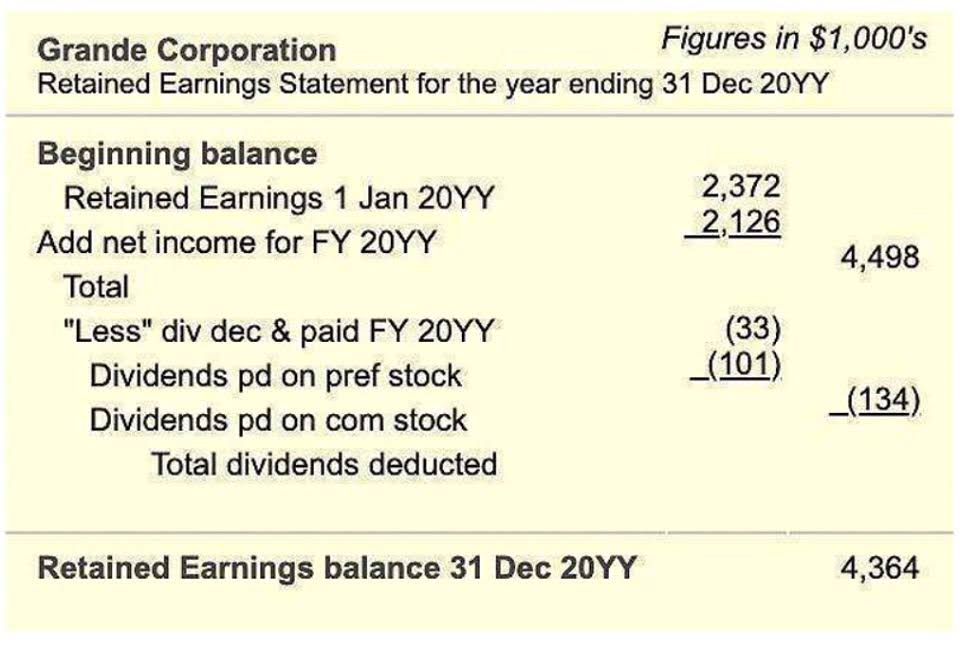
  • The net income or loss for the period is used to calculate the change in retained earnings.
  • Let us assume that the company paid out $30,000 in dividends out of the net income.
  • The statement of retained earnings is also known as the retained earnings statement, the statement of shareholders’ equity, the statement of owners’ equity, and the equity statement.
  • Retained earnings and profits are related concepts, but they’re not exactly the same.

Retained Earnings Formula

We believe everyone should be able to make financial decisions with confidence. Certain services available through Brex may be provided by Brex Payments LLC (NMLS # ), an affiliate of Brex and a licensed money transmitter. The use of Brex’s platform is subject to eligibility requirements and terms of service, learn more at Brex.com/legal. Service-specific terms apply, including but not limited to our Brex Card Program Terms, Rewards Terms and Travel Terms. Offers contingent on using Brex services are subject to qualifying for those services. Increase branding and spending more on research and development is also important in this stage.

The retained earnings account is updated at the end of each accounting period, reflecting the changes in net income, dividend payments, and any other adjustments. By analyzing the retained earnings account, investors and analysts can gain valuable insights into a company’s financial performance, growth potential, and ability to create value for shareholders. Retained earnings are prominently displayed in the shareholders’ equity section of the balance sheet, alongside components like common stock and additional paid-in capital. This placement emphasizes their role in evaluating a company’s financial health. The retained earnings statement itself, though concise, provides a detailed reconciliation of changes over a specific period, offering insights into profitability and dividend policies. Presented with the income statement and balance sheet, it provides a comprehensive view of financial performance.

The statement can be prepared to cover a specified cycle, either monthly, quarterly or annually. In the United States, it is required to follow the Generally Accepted Accounting Principles (GAAP). At the end of a given reporting period, any net income that is not paid out to shareholders is added to the business’s retained earnings. When a company generates net income, it is typically recorded as a credit to the retained earnings account, increasing the balance.

  • Accounting standards like GAAP and IFRS require transparent disclosure of adjustments to retained earnings, whether due to prior period errors or policy changes.
  • Since we have all the balances we need for preparing a statement of changes in equity, it will look like this.
  • It’s also sometimes called the statement of shareholders’ equity or the statement of owner’s equity, depending on the business structure.
  • By comprehending the choreography between beginning balance, net income, and dividends, you’ve gleaned how a statement of retained earnings is not just interpreted but also orchestrated.
  • Non-cash items like write-downs, impairments, and stock-based compensation are the behind-the-scenes crew that also influence the plot.
  • After subtracting the amount of dividends, you’ll arrive at the ending retained earnings balance for this accounting period.

This statement might also show the adjusting transactions made during the year and the effect on retained earnings. This statement tied the income statement and balance sheet through net income made during the year. The entity may not prepare this statement, but they may use the statement of change in equity and balance sheet instead. account management software and account management tools To calculate the shares issued at par value at the beginning of the accounting period as given in the table, we need to divide the value of issued shares by the par value.

Statement of retained earnings vs Statement of Cash flows

The statement can be used to help investors and creditors understand a company’s financial health and performance. Retained earnings are recorded under the shareholders’ equity section of the balance sheet. They reflect the cumulative profits retained by the company over time, minus any dividends distributed to shareholders. At the end of each accounting period, net income (or loss) is transferred from the income statement to the retained earnings account through a closing entry.

These payouts are like a “thank you” to the investors who bank on your success. But, don’t forget, dividends are a slice out of your profit pie, directly nibbling away at your retained earnings. To calculate retained earnings to market value, divide the share price by the retained earnings per share. For example, suppose your company’s share price increased from $10 to $60 over the past five years and the total earnings retained per share over the same five years is $5. If you’re an investor who likes consistent income, investing in mature companies is a great way to benefit from potential long-term capital appreciation and consistent dividends.

The net income amount in the above example is the net profit line item, which is $115,000. The company retains the money and reinvests it—shareholders only have a claim to it when the board approves a dividend. This reduction happens because dividends are considered a distribution of profits that no longer remain with the company. Retained earnings are door hangers are also known as accumulated earnings, earned surplus, undistributed profits, or retained income. Retained earnings act as a reservoir of internal financing you can use to fund growth initiatives, finance capital expenditures, repay debts, or hire new staff.

What happens if I change the retained earnings account?

They increase with a credit entry, and retained earnings decrease with a debit entry. Profits generally refer to the money a company earns after subtracting all costs and expenses from its total revenues. Examples of these items include sales revenue, cost of goods sold, depreciation, and other operating expenses. Non-cash items such as write-downs or impairments and stock-based compensation also affect the account.

There’s almost an unlimited number of ways a company can use retained earnings. With plans starting at $15 a month, FreshBooks is well-suited for freelancers, solopreneurs, and small-business owners alike. It can go by other names, such as earned surplus, but whatever you call it, understanding retained earnings is crucial to running a successful business.

Statement of Retained Earnings: What It is and Example

It simply means that the company has paid out more to its shareholders than it has reported in profits. It’s easy to mistake retained earnings for an asset because companies use them to buy inventory, equipment, and other assets. But a retained earnings account is reported on the balance sheet under the shareholders’ equity, so they’re treated as equity.

Does common stock go on the statement of retained earnings

It’s deceptively simple, but each line represents a story about the company’s profitability and how it chooses to use that profit. Here’s where eyes tend to linger and decisions begin to form based on how the numbers play out. Unappropriated earnings—as you may have guessed—are the amount of earnings not appropriated at the end of a given period. These earnings are typically also used for growth, but they’re not earmarked for a specific transaction or project. Note that “Dividends” include all types of dividends, including stock issuances. In this article, we discuss how retained earnings work, why companies rely on them, and how they can impact the business trajectory.

  • That amount is added to the original $100,000 for a new total retained earnings of $130,000.
  • Conversely, declining retained earnings might align with strategic initiatives like share buybacks or high dividends to attract investors.
  • If your business recorded a net profit of, say, $50,000 for 2021, add it to your beginning retained earnings.
  • If your company is very small, chances are your accountant or bookkeeper may not prepare a statement of retained earnings unless you specifically ask for it.
  • It’s crucial to remember that sales revenue, cost of goods sold, depreciation, and operating expenses—among other line items on your income statement—play a big part in shaping this number.

Setting up a Statement of Retained Earnings

Retained earnings are profits not paid out to shareholders as dividends; that is, they are the profits the company has retained. Retained earnings increase when profits increase; they fall when profits fall. You will need to list your amount of retained earnings at the end of the previous accounting period. You can obtain this information from your business’s balance sheet or previous statement of retained earnings. In GAAP, the statement of retained earnings can be attached to the income statement, or the balance sheet, or be prepared as a separate financial statement. The beginning retained earnings is derived from the balance sheet of the previous accounting period while the Net income is derived from the income statement.

Statement of Retained Earnings is One Piece of the Puzzle

Investors look at the current year’s and previous year’s retained earnings balance to predict future dividend payments and growth in the company’s share price. Retained earnings represent a useful link between the income statement and the balance sheet, as they are recorded under shareholders’ equity, which connects the two statements. This reinvestment into the company aims to achieve even more earnings in the future.

Strategic use of retained earnings can improve return on equity, a critical measure of how efficiently equity capital generates profits. Understanding the retained earnings statement is crucial for analyzing a company’s financial health. This document reveals how much profit has been reinvested in the business rather than distributed as dividends, offering insights into growth potential and stability. Your beginning retained earnings are the funds you have from the previous accounting period.

But bear in mind, this isn’t a compulsory tradition; some companies choose to reinvest profits back into the business instead. Your company could decide to reinvest the earnings back into the business instead. If you do pay out, it reflects in your retained earnings as a reduction, affecting your equity’s bottom line.

Arjun has since written for investment firms, consultants, and SaaS brands in the Accounting and Finance space. Higher retained earnings may be a sign of a company’s financial strength as it saves up funds to expand—or it could be a missed opportunity for paying dividends. Generally, companies like to have positive net income and positive retained earnings, but this isn’t a hard-and-fast rule. The decision to pay dividends or retain earnings for future capital expenditures depends on many factors. They’re found in the balance sheet under equity and show financial health and reinvestment capacity. These programs are designed to assist small businesses with creating financial statements, including retained earnings.

  • Your beginning retained earnings are the funds you have from the previous accounting period.
  • The amount of retained earnings is calculated by adding the net income of the company to the beginning retained earnings and subtracting any dividend payments made to shareholders during the period.
  • This statement can signal either growth potential or a warning bell of upcoming financial troubles, making it a crucial document for investors, shareholders, and directors alike.
  • It’s the amount your company is left with after subtracting all expenses, including operating and non-operating expenses, one-off expenses, and taxes.
  • You must use the retained earnings formula to set up your statement of earnings.
  • Brex also provides a Brex Card issued by Sutton Bank, Member FDIC, pursuant to a license from Visa® U.S.A. Inc.

The specific use of retained earnings depends on the company’s financial goals. Ultimately, the company’s management and board of directors decides how to use retained earnings. If a company decides not to pay dividends, and instead keeps all of its profits for internal use, then the retained earnings balance increases by the full amount of net income, also called net profit. A statement of retained earnings details the changes in a company’s retained earnings balance over a specific period, usually a year.

The Best Shopify Accounting Software: Our Top Seven Picks

(“Column”), member FDIC, and Treasury and Vault, which are cash management services offered by Brex Treasury LLC (“Brex Treasury”), member FINRA/SIPC, an affiliate of Brex. As you can see, at the first of this statement, there is the opening balance of accumulated earnings that was brought forward from the debt to equity d previous year’s accumulated earnings. There are key differences between the two accounting standards (GAAP vs IFRS) that impact the statement of retained earnings. The par value of ordinary shares is the face value of the shares as decided by the company in its articles of incorporation (corporate charter).

How to calculate the shares issued

Since we are given the dividends declared, this would be recorded under the retained earnings because dividends reduce the balance of the retained earnings. Therefore, the dividends declared would be – $20,000; we would add the dividends in brackets to show that it is negative or that it is reducing the retained earnings. Dividends are negative because paying dividends takes money out of the account of a company. The ending balances at 29 February 2019 (in the equity section of the balance sheet) become our balances at the beginning of the current reporting period (in our equity statement), 01 March 2019. Corporations often use the Income Statement instead of a dedicated Statement of Retained Earnings.

Like I earlier said, always take note of the dates and also take note of the type of shares that is receiving the dividends. In this example, the ordinary dividends were declared on all shares that are held at 28 February 2022 at $0.35 per share. This means we must calculate the total number of shares issued from the beginning of the accounting period and also add the additional shares issued during the accounting period.

Trial Balance

This figure is derived from the ending retained earnings of the previous period’s financial statements. Analysts should confirm its alignment with historical records to ensure accuracy, as discrepancies may indicate errors or adjustments. Consistency in this balance, as required by GAAP or IFRS, ensures transparent reporting. It provides a baseline for assessing how effectively a company has utilized its retained earnings.

Role in Shareholders’ Equity

The amount retained still belongs to the equity holders and forms part of the owners equity. Retained earnings refers to the net income retained by a business after any distribution (dividends) to the equity holders. In effect the net income is split between the amount paid out to equity holders and the amount retained within the business. Conversely, cash on hand is the literal liquid assets—currency, bank account balances, easily accessible funds—that a company can quickly mobilize for immediate needs, emergencies, or opportunities. Retained earnings aren’t just a scorecard of past triumphs; they set the stage for future financial leaps.

Yes, retained earnings can turn negative if a company consistently loses money or pays out more in dividends direct marketing sales strategy than it earns. This is often pointed out as an accumulated deficit and can indicate financial trouble. Learn how to build, read, and use financial statements for your business so you can make more informed decisions. Based on the amount of net income earned, your company might decide to pay a certain portion to shareholders as dividends.

They say money talks, and in this case, the conversation between your net income and beginning retained earnings is pivotal. You’ll add profits, or deduct losses, to calculate how much wealth stays in the company’s pocket. A solid grasp of retained earnings begins with understanding the starting how to calculate sales tax balance.

Self-paced Classes

By learning how to effectively use QuickBooks, you can streamline your accounting processes and reduce manual errors. This not only saves time but also ensures greater accuracy in your financial records. But with so many training options available, how do you decide which QuickBooks course is right for you? This guide will help you explore the various QuickBooks training options, outline their benefits, and show you how upskilling QuickBooks knowledge can give you a leading edge. Get a free priority listing on our Find-a-ProAdvisor online directory, showcasing your skills and services to a vast range of potential new clients.

QuickBooks Training class Chicago

If you want to master QuickBooks, you can sign up for a paid course through Advanced Webinars. They’re all certified under the Certified User program, and many are former teachers. In conclusion, investing in QuickBooks training not only improves your proficiency in using the software but also contributes to your overall upskilling and career advancement.

QuickBooks Training class Stamford

Training will teach you how to create these reports and interpret them accurately, helping you make informed business decisions. This is one of QuickBooks’ most popular features, as it enables businesses to easily track their expenses and manage payroll all in one place. With the right training, you can learn how to set up payments, automate tasks, and even file taxes directly through the software.

QuickBooks Training class Detroit

  • Get a free priority listing on our Find-a-ProAdvisor online directory, showcasing your skills and services to a vast range of potential new clients.
  • With the right training, you can learn how to set up payments, automate tasks, and even file taxes directly through the software.
  • Intuit, the company that created QuickBooks, offers bookkeeper certifications through Coursera.
  • In this lesson, we cover how to deposit payments that are combined with other payments and taken to the bank at once.
  • QuickBooks Training provides online, self-paced courses for both the Online and Desktop versions.
  • Courses include on-demand video lectures, homework exercises, and community discussion forums.

QuickBooks does simplify the bookkeeping process, but bookkeeping in Ukraine or Russia is very complicated. We have found that however user friendly, some level of training and support is needed. He has a CPA license in the Philippines and a BS in Accountancy graduate at Silliman University. Intuit QuickBooks Training offers both live classes and self-paced training sessions (VIP Membership). Live Classes are $799.95 for the first attendee, with $250 off for each additional attendee.

QuickBooks Online users who want to expand their expertise with advanced features. Having QuickBooks certification on your resume can make you a more attractive candidate to potential employers. It shows that you have the skills and knowledge to effectively manage financial tasks using this popular software.

Developed by Intuit, it is accounting software designed for small and medium-sized businesses. With over 30,000 courses across 190 countries, The Knowledge Academy is one of the world’s largest providers of training courses globally. It provides courses in categories such as business analysis, project management, business accounting, and bookkeeping. The Knowledge Academy’s courses generally have a higher price tag than Coursera and the Corporate Finance Institute.

With this QuickBooks Online course, you can boost your accounting capabilities by learning, in a simplified way, how to use this robust software. You’ll start with the basics and then be led towards understanding the tools and features that can help you solve your accounting challenges. QuickBooks training courses are designed for individuals with varying levels of expertise, from beginners to experienced professionals. The QuickBooks training tutorials offered by Hector Garcia are in a live class and self-paced format. Live web-based courses usually last for three hours; after which, a recording will be available to those who wish to learn at their own pace.

Combined Payments

Stand out from the crowd and show prospective clients that you’re an expert by using official ProAdvisor badges on sites, directories, and social profiles. Learn how to optimize QuickBooks to deliver powerful accounting workflows with hands-on, media-rich certifications—all in our ProAdvisor Academy. Learn key product features and tools, and see how they help you grow and manage your practice. Share tutorials and webinars that can help your clients get the most out of QuickBooks.

Bank Feeds Dashboard

  • Discover how to optimize your workflow, utilize powerful advanced features, and gain deeper insights into your business’s financial performance.
  • You get full value out of this software by having a well done setup and implementation activities.
  • Simplify training with an accredited library and an easy-to-use course builder.
  • If you have a specific question about using QuickBooks, QuickBooks Support is a free and comprehensive resource.
  • The tutorials are broken into bite-sized segments, making them easier to digest.
  • Consider your business requirements and preferences to determine the best fit.

By signing up for QuickBooks Online Accountant, you automatically unlock ProAdvisor benefits to help you land ideal clients, learn new skills, and get premier product support. Accelerate your professional development with actionable, live trainings taught by Advanced Certified ProAdvisors. Earn CPE credits and learn however you like—from webinars to virtual conferences to in-person events. The courses provide training on the more extensive parts of QuickBooks Online, including bank reconciliations and VAT returns.

Sign up to receive more well-researched small business articles and topics in your inbox, personalized for you. Crystalynn Shelton is an Adjunct Professor at UCLA Extension, where she has taught small business owners how to set up and manage their books. She is also a CPA and QuickBooks ProAdvisor and specializes in QuickBooks consulting online quickbooks expert training and training. These QuickBooks training courses are all free of charge with no email required. Sign up to receive more well-researched accounting articles and topics in your inbox, personalized for you.

This course is designed for experienced users ready to unlock advanced functionalities. While less common in the digital age, in-person workshops offer an immersive experience where learners can gain hands-on practice in a focused environment. Keep in mind that these workshops often require travel, and scheduling may be less convenient.

Taxation Defined, With Justifications and Types of Taxes

tax & bookkeeping services fort lauderdale

Some jurisdictions impose taxes on financial or capital transactions. Tax rates are generally fixed, bookkeeping services fort lauderdale but a different rate may be imposed on employers than on employees.15 Some systems provide an upper limit on earnings subject to the tax. A few systems provide that the tax is payable only on wages above a particular amount. Such upper or lower limits may apply for retirement but not for health-care components of the tax.

IRS Direct File

Levied and enforced at the federal level, these are taxes on the profit generated when you sell an asset that’s increased in value. We offer free one-on-one audit guidance year-round from our experienced and knowledgeable tax staff. Our calculations are 100% accurate so your taxes will be done right, guaranteed, or we’ll pay you any IRS penalties. TurboTax calculations are 100% accurate so your taxes will be done right, guaranteed, or we’ll pay you any IRS penalties. In accordance with the requirements of Title II of the Americans with Disabilities Act of 1990 (“ADA”), the City of Columbia will not discriminate against qualified individuals with disabilities on the basis of disability in its services, programs, or activities. In monetary economies prior to fiat banking, a critical form of taxation was seigniorage, the tax on the creation of money.

tax & bookkeeping services fort lauderdale

We can help you get ready for tax time

All features, services, support, prices, offers, terms and conditions are subject to change without notice. With a rich historical background and promises of a strong future, Lexington County provides a diverse community, endless economic opportunities and prosperous growth. Located in the Midlands of South Carolina, Lexington County is known as one of the fastest growing areas in the state and region. As a leader in business and industry, Lexington County provides an outstanding quality of life with a reasonable cost of living.

ADA Policy

  • Therefore, the total remitted is 15.3% (6.2% employee Social Security + 6.2% employer Social Security + 1.45% employee Medicare + 1.45% employer Medicare).
  • Tax revenues are used for public services and the operation of the government, as well as for Social Security and Medicare.
  • This fact can be used as the basis for practical or moral arguments in favor of tax simplification (such as the FairTax or OneTax, and some flat tax proposals).
  • These reforms included converting three individual income tax brackets into one and moving from a top marginal rate of 4.25 percent to a single rate of 3 percent.
  • Tax choice is the theory that taxpayers should have more control with how their individual taxes are allocated.
  • However, who ultimately pays the tax (the tax „burden”) is determined by the marketplace as taxes become embedded into production costs.

Among other things, this money is spent to improve and maintain public infrastructure, including the roads we travel on, and fund public services, such as schools, emergency services, and welfare programs. Anyone who earns more than $200,000 as a single filer (or $250,000 for married couples filing jointly) pays an additional 0.9% into Medicare. Additionally, critics of taxation note that the process of taxation, not only unjustly takes money of citizens, it also unjustly takes considerable time away from citizens. For example, it is estimated by the American Action Forum that Americans spend 6.5 billion hours annually preparing their taxes.101102 This is equivalent of roughly 741,501 years of life lost QuickBooks every year to complete tax forms and other related paperwork.

tax & bookkeeping services fort lauderdale

The classic ways of cheating a tariff are smuggling or declaring a false value of goods. Tax, tariff and trade rules in modern times are usually set together because of their common impact on industrial policy, investment policy, and agricultural policy. A trade bloc is a group of allied countries agreeing to minimize or eliminate tariffs against trade with each other, and possibly to impose protective tariffs on imports from outside the bloc. A customs union has a common external tariff, and the participating countries share the revenues from tariffs on goods entering the customs union. The Numero De Identificacion Tributaria is 10 digits in the format NNN.NNN.NNN-N where the last digit is a verification digit. It is assigned by the National Tax and Customs Directorate (DIAN) to taxpayers, responsible parties, withholding agents and those obliged to file tax returns and must be used when this entity indicates.

  • Individual income taxes are a major source of state government revenue, accounting for 33 percent of state tax collections in fiscal year 2023, the latest year for which data are available.
  • Such upper or lower limits may apply for retirement but not for health-care components of the tax.
  • Payroll taxes are withheld from an employee’s paycheck by an employer, who remits the amount to the federal government to fund Medicare and Social Security programs.
  • Capital gain is generally a gain on sale of capital assets—that is, those assets not held for sale in the ordinary course of business.
  • For a period of over 150 years from 1695, the government of England levied a window tax, with the result that one can still see listed buildings with windows bricked up in order to save their owner’s money.
  • Between 1817 and 1861, the federal government collected no internal revenue.

Property taxes

The maximum estate tax rate of 40% is levied on the portion of an estate that https://www.bookstime.com/ exceeds the exclusion limit by more than $1 million. To help fund public works and services—and to build and maintain the infrastructure used in a country—a government usually taxes its individual and corporate residents. The tax collected is used for the betterment of the economy and all who are living in it.

They found that domestic revenue flows are, on average, already much larger than ODA, with aid worth less than 10% of collected taxes in Africa as a whole. The tax system and its administration also play an important role in state-building and governance, as a principal form of „social contract” between the state and citizens who can, as taxpayers, exert accountability on the state as a consequence. This includes natural resources consumption tax, greenhouse gas tax (i.e. carbon tax), „sulfuric tax”, and others. The stated purpose is to reduce the environmental impact by repricing.

  • Taxes are mandatory contributions levied on individuals or corporations by a government entity—whether local, regional, or national.
  • The formulation of tax policies is one of the most critical and contentious issues in modern politics.
  • This suggests countries making the most progress replacing aid with tax revenue tend to be those benefiting disproportionately from rising prices of energy and commodities.
  • Most taxes—including income tax and sales tax—can have significant deadweight costs.
  • When it comes to estate and inhertiance, taxes also vary widely from state to state.

tax & bookkeeping services fort lauderdale

An ad valorem tax is one where the tax base is the value of a good, service, or property. Sales taxes, tariffs, property taxes, inheritance taxes, and value-added taxes are different types of ad valorem tax. An ad valorem tax is typically imposed at the time of a transaction (sales tax or value-added tax (VAT)) but it may be imposed on an annual basis (property tax) or in connection with another significant event (inheritance tax or tariffs). Many jurisdictions tax the income of individuals and of business entities, including corporations. Generally, the authorities impose a tax on net profits from a business, on net gains, and on other income.

PHENOGY AG outlines growth strategy in Columbia, strengthening City’s role in clean energy innovation

The government compels taxation through an implicit or explicit threat of force. Taxation is legally different than extortion or a protection racket because the imposing institution is a government, not private actors. As of January 1, 2025, New Hampshire repealed its interest and dividends tax, joining the group of seven other states with no individual income tax.

Multi-Step Income Statement An In-Depth Financial Reporting Guide

This comprehensive approach ensures that the guide not only serves as an introduction but also as a stepping stone to more advanced financial education and analysis. When preparing and analyzing a multi-step income statement, certain pitfalls can significantly affect the accuracy and usefulness of the financial document. Understanding bank reconciliation these common mistakes can help ensure the integrity of the financial analysis.

Multi-Step Income Statement by Time

Unlike the operating section, the non-operating section is not split into subcategories. Gross profit is the first section of a multi-step income statement, and it is obtained by deducting the cost of goods sold from the total sales. Gross profit is used by creditors to show the company’s ability to meet arising debt obligations and to pay back outstanding credit. Preparing a multi-step income statement starts with gathering and organizing financial data. Collect data from sources like sales records, invoices, payroll, and expense reports, verifying accuracy to avoid discrepancies. When forecasting income, it is important to have detailed historical data for accurate predictions of business.

  • Margin of safety is the amount of a company’s profit after subtracting its break-even point.
  • The Multi-Step Income Statement allows for more in-depth analysis compared to a Single-Step Income Statement.
  • In the above example, we follow the periodic format to compute the Cost of Goods Sold.
  • The articles and research support materials available on this site are educational and are not intended to be investment or tax advice.
  • Add the final number as a line item under the cost of goods sold and title it Gross Profit.
  • And the Company’s Operating income is calculated by deducting these total operating expenses from the gross profit in the first section.

Resources

A multi-step income statement also differs from an income statement in the way that it calculates net income. A single-step income statement includes just one calculation to arrive at net income. Multi-step income statements, on the other hand, use multiple equations what is a flat rate pricing model pros and cons explained to calculate net income. In doing so, they also calculate gross profit and operating income, which aren’t included on a single-step income statement. In comparison, a single-step income statement gives a simple record of financial activity.

  • As the revenue and expenses are segregated into operating and non-operating accounts, it provides greater insight into the company’s financial performance.
  • Once collected, categorize the data into sections aligned with the statement’s format.
  • Given the gross profit of Apple for each period, the next step is to subtract operating expenses to determine the company’s operating profit in each fiscal year.
  • Since it is strikingly similar to the “cash from operations” section on the cash flow statement.
  • Overcoming these challenges is crucial as the accurate preparation of the income statement significantly impacts the financial reporting, influencing the decisions made by the stakeholders and potential investors.

What Is Good General Ledger Accounting?

Given the gross profit of Apple for each period, the next step is to subtract operating expenses to determine the company’s operating profit in each fiscal year. The multi-step income statement is a method of presenting the financial results of a company by segmenting the revenue, costs, and expenses into distinct sections. The Multi-Step Income Statement is a financial reporting format where a company’s revenue, costs, and expenses are classified into separate categories before arriving at net income (the “bottom line”). The format of the multi-step income statement contains Selling and Admin Expenses as the second section. It notes all company operating expenses in two categories that are Selling and Administrative. The third section is the non-operating head, which lists all business incomes and expenses that are not related to the principal activities of the business.

Format

The gain may be a one-time item such as a winning lawsuit or insurance settlement. The gain does not relate to the company’s core business activities, so it is listed in the non-operating section of the income statement. It is simply Cash Inflow from Merchandise sales and Cash Outflow from purchasing the merchandise. This section helps measure the health of business and the profitability of core business activities. Assembling a multi-step income statement involves more than just inputting numbers—it’s about presenting a clear narrative of the company’s in a bank reconciliation deposits in transit should be financial performance.

#2 – Operating Head – Selling and Admin Expenses

Join millions of self-starters in getting business resources, tips, and inspiring stories in your inbox. Start your free trial with Shopify today—then use these resources to guide you through every step of the process. Discover the next generation of strategies and solutions to streamline, simplify, and transform finance operations.

What measures of profit are reported on a multi-step income statement?

Once the non-operating section is totaled, it is subtracted from or added to the income from operations to compute the net income for the period. It is important to accurately list and categorize each expense to ensure that all operating costs are accounted for and properly managed. Barbara is a financial writer for Tipalti and other successful B2B businesses, including SaaS and financial companies. She is a former CFO for fast-growing tech companies with Deloitte audit experience.